The Ultimate James Smith Calorie Deficit Calculator 2026
| Plan | Deficit | Daily Target | Est. Loss/Week | Weeks to −5kg |
|---|
You’ve tried cutting carbs. You’ve skipped breakfast. You’ve eaten “clean” for two weeks straight. And the scale still hasn’t moved. Sound familiar?
The truth is, weight loss isn’t about willpower or the perfect diet. It comes down to one simple thing: how many calories you eat versus how many your body actually needs. The issue is that no one shares your real number, so you end up guessing. This can lead to cutting too much, giving up too soon, or feeling confused.
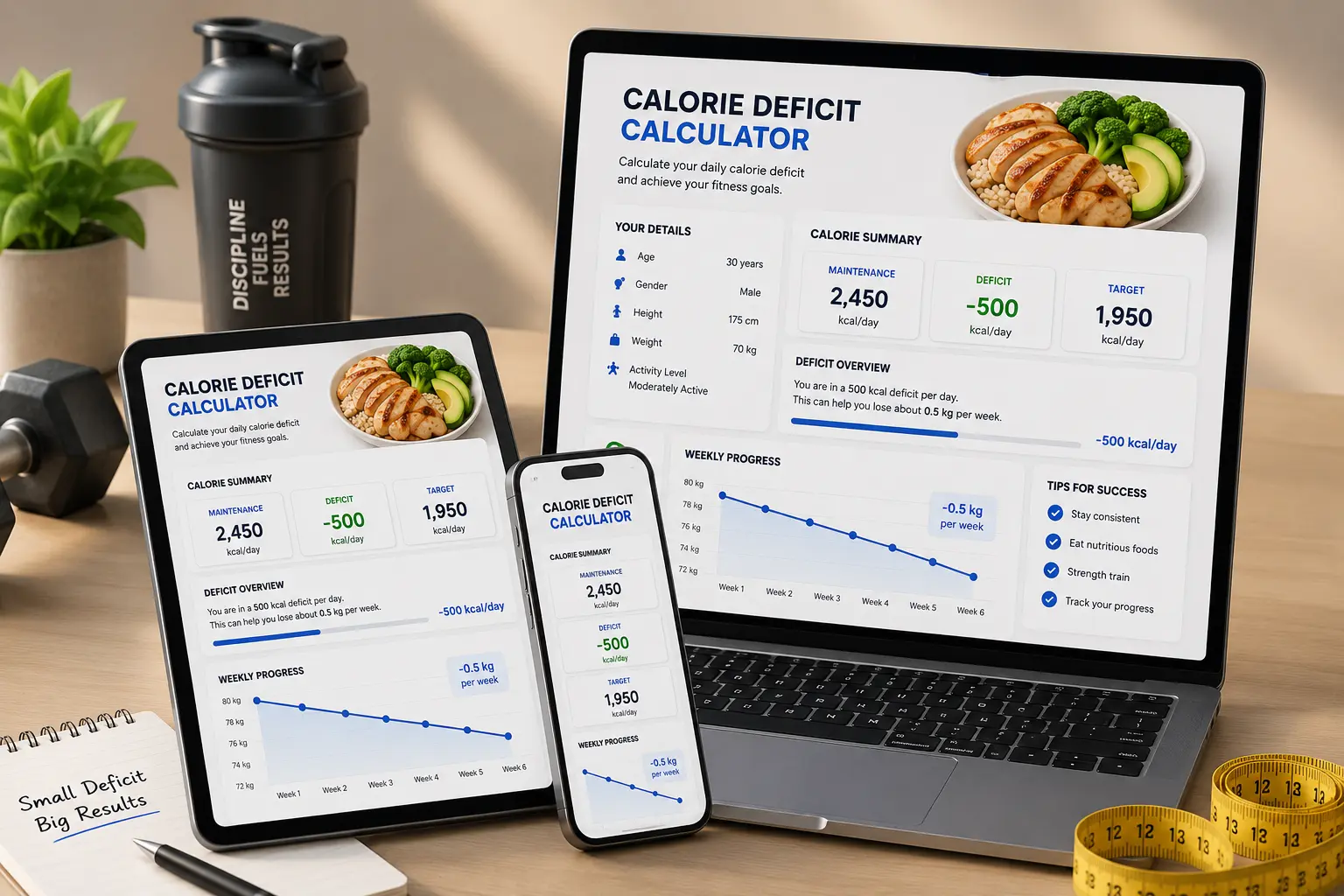
That’s exactly why we built this James Smith calorie deficit calculator. In under a minute, it provides one clear number based on your age, weight, height, and activity level. No guessing. No starving yourself. A simple, personal target you can actually stick to.
This guide explains what a calorie deficit is. It shows you how to figure out your needs. You can use that information to lose weight safely and simply.
What Is a Calorie Deficit?
A calorie deficit means you eat fewer calories than your body burns in a day. This James Smith calorie deficit calculator works out that gap for you. When this happens, your body needs more energy, so it draws it from your stored body fat.
In simple words:
Calories eaten < Calories burned = Weight loss
That sounds easy. And it is easy to understand. The hard part is knowing your own numbers and sticking to them.
That is where a free calorie deficit calculator helps. You don’t have to guess. You enter a few details, and you get a daily calorie number made for you. Calculating calorie deficit by hand is simple. However, a calculator can give you the same answer in seconds.
How Does a Calorie Deficit Calculator Work?
This calculator uses two main numbers: your BMR and your TDEE.
Basal Metabolic Rate (BMR)
Your BMR is the number of calories your body needs just to stay alive. This is the energy you use to breathe, pump blood, and keep your organs working — even if you stay in bed all day. We use the Mifflin-St Jeor formula, which most experts agree is the most accurate one:
- Men: BMR = (10 × weight in kg) + (6.25 × height in cm) − (5 × age in years) + 5
- Women: BMR = (10 × weight in kg) + (6.25 × height in cm) − (5 × age in years) − 161
Total Daily Energy Expenditure (TDEE)
Your BMR only counts resting energy. Once you add walking, working, and exercise, you get your TDEE. This is the real number of calories your body burns in a normal day.
TDEE = BMR × Activity Level
Your TDEE is your maintenance number. If you eat this much, your weight should stay the same. To lose weight, you eat less than this number. The gap between what you eat and your TDEE is your calorie deficit.
You can use this as a standalone TDEE calculator. Skip the deficit step above. Then, use the TDEE result as your daily target.
James Smith Calorie Deficit Calculator: His Approach Explained
James Smith believes weight loss should be simple. You don’t need extreme diets or “magic” foods. In his books and videos, he says the same thing again and again: track your numbers, stay consistent, and give it time.
This calculator follows the same idea. It does not try to give you the largest possible number. It provides a number you can stick to. This number fits into your normal week, unlike others that only work for a few days before you quit.
How Big Should Your Calorie Deficit Be?
Many people think bigger is always better. That’s not true. The best calorie deficit calculator answers this question for you. It uses your body’s specifics, not a generic guess.
- A small deficit of 300–500 calories a day works best for most people. This usually means losing about 0.25–0.5 kg (0.5–1 lb) a week, which is a safe speed
- A larger deficit of 500–750 calories can lead to faster weight loss, but you may feel hungrier and more tired. You could also lose muscle along with fat
- A deficit of more than 1,000 calories is not usually advised unless a doctor is watching your progress. It can lead to low energy and a slower metabolism.
NHS guidance says women should eat at least 1,200 calories a day. Men should aim for about 1,500 calories daily. This is unless a doctor advises otherwise.
Calorie Deficit Calculator: UK Guidance
For a reliable calorie deficit calculator, UK users can trust these numbers. They match NHS weight loss advice. The NHS often suggests cutting about 600 calories a day to start, along with regular exercise. Many people look for a calorie deficit calculator as the NHS uses. They want one that sticks to safe limits, not extreme numbers.
A few tips to remember if you’re using NHS-style guidance:
- Try to lose about 0.5–1 kg a week, not faster
- Add at least 150 minutes of exercise each week
- Treat your calculator result as a starting point. Check again after 2–3 weeks
- Talk to a doctor or dietitian first if you are pregnant, breastfeeding, have PCOS or a thyroid problem, or are under 18
This calculator works as a reliable calorie estimator for weight loss, but it does not replace advice from a doctor.
How to Create a Calorie Deficit
Once you know your number, you can find your calorie deficit in three easy ways. This will help you see real results:
1. Eat Less
This is the most direct way. Don’t just guess your portions — try this instead:
- Track everything you eat for one week, including oils, sauces, and drinks. These small extras add up fast
- Eat whole foods like vegetables, lean meat, and whole grains. They fill you up for fewer calories
- Check calories per 100g, not per “serving.” Serving sizes on packets are often too small
2. Move More
When you move more, you burn more calories, even without eating less.
- Add 1–2 extra walks each day.
- Do strength training 2–3 times a week. This helps you keep muscle while losing fat, which keeps your metabolism strong
3. Do Both
This works best for most people. Eating a little less and moving a little more is easier to keep up with than doing one.
Calorie Deficit Calculator Example
Let’s see how this works with real numbers.
Say a 30-year-old woman weighs 70kg, is 165cm tall, and works out 3 times a week (moderately active).
Step 1: Find her BMR BMR = (10 × 70) + (6.25 × 165) − (5 × 30) − 161 BMR = 700 + 1,031 − 150 − 161 = 1,420 calories
Step 2: Find her TDEE, calculated as BMR multiplied by 1.55 for a moderately active lifestyle. TDEE equals 1,420 multiplied by 1.55, resulting in 2,201 calories.
Step 3: Apply a calorie deficit. For safe weight loss, she subtracts 400 calories: 2,201 − 400 = 1,801 calories a day.
This means she should eat around 1,800 calories a day to lose weight at a safe, steady pace of about 0.4 kg per week. This calculator provides this type of number in a short amount of time. It uses your own details, not someone else’s.
The Role of Macros in a Calorie Deficit
Calories decide if you lose weight. Macros (protein, fat, and carbs) decide what you lose and how you feel. Once your calorie deficit calculator gives a daily number, break it into the right macros.
Protein is the most important macro when you’re in a deficit. It keeps you full, protects your muscles, and burns a few extra calories when your body digests it. Good sources are chicken, fish, eggs, Greek yoghurt, lentils, and protein powder.
Fats help make hormones and help your body use vitamins A, D, E, and K. Don’t cut fat too low. Good sources are olive oil, nuts, and oily fish.
Carbs give you energy for workouts and for your brain. Slow carbs, like oats, whole-grain bread, and veggies, keep your energy steady. They do this better than sugary foods.
Want to know how much protein, fat, and carbs you need? Try our Macro Calculator for Weight Loss. It uses the numbers from this calculator.
Why Am I Not Losing Weight in a Calorie Deficit?
If you’re in a deficit but not losing weight, it’s usually not because “calories don’t work.” It’s usually one of these:
- Tracking mistakes — forgetting oils, snacks, or drinks can cancel out your whole deficit
- Alcohol — drinks have about 7 calories per gram, so a few drinks a week add up fast
- Bad sleep — less than 7 hours a night can make you hungrier and cause cravings
- Too much stress — stress can raise hunger and cause your body to hold onto water
- Your body is adjusting — as you lose weight, your TDEE goes down too, so your old deficit may need updating
- Too much patience too soon — the first week often shows fast loss from water, then it slows down. This is normal
If you’ve checked everything and still feel stuck, try using your current weight to recalculate your numbers. Don’t rely on your starting weight.
Calorie Calculator for weight Loss: How It Compares
| Feature | This Calculator | MyFitnessPal | RP Strength |
|---|---|---|---|
| Free to Use | ✅ Yes | ⚠️ Limited Free Version | ❌ Paid App Needed |
| Uses Mifflin-St Jeor Formula | ✅ Yes | ⚠️ Varies | ✅ Yes |
| UK/NHS-Based Guidance | ✅ Yes | ❌ No | ❌ No |
| Sign-Up Needed | ✅ No | ✅ Yes | ✅ Yes |
| Macro Breakdown Included | ✅ Yes, Linked Tool | ✅ Yes (Paid) | ✅ Yes (Paid) |
Commonly Asked Questions
Final Thoughts
A calorie calculator for weight loss won’t do the work for you. But it removes the guessing. Once you know your number, stay consistent. Track with integrity, train with dedication, and prioritise adequate sleep. Give it a few weeks before checking your results.
Use our Daily Calorie Intake Calculator to check your maintenance number too. Or visit the James Smith Calculator hub to see all our tools — for fat loss, muscle gain, and protein intake.
Ready to Find Your Number?
Stop guessing how many calories you need. Use the free James Smith Calorie Deficit Calculator now and get your personal daily target in under a minute — no sign-up, no app, just your number.
Calculate My Calorie Deficit →